Wholesale Real Estate Disposition: How to Get the Contract Sold
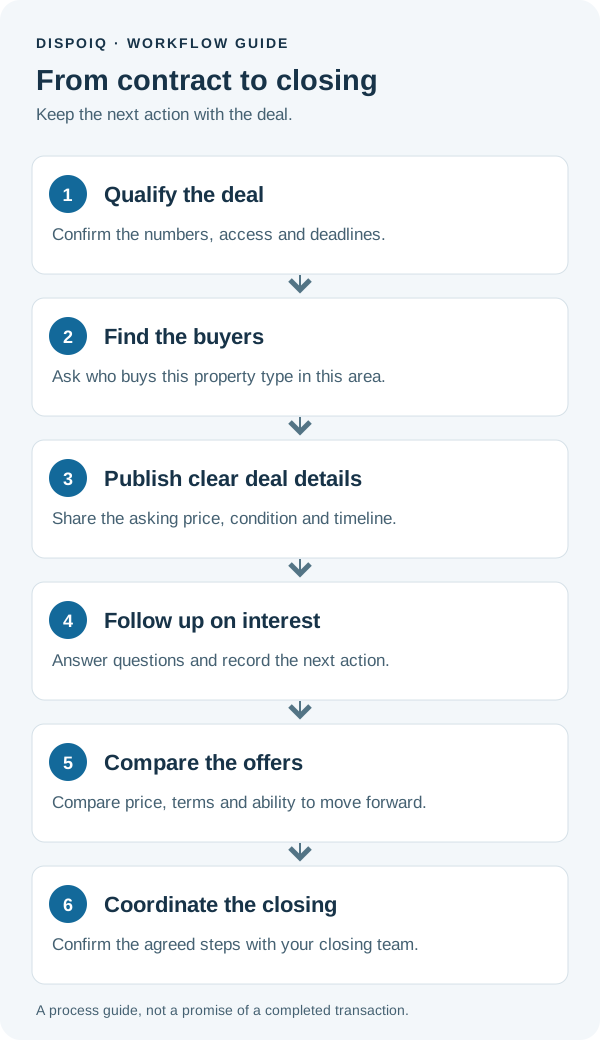
Wholesale real estate disposition is the work of finding an end buyer for a deal under contract and getting the agreed transaction to closing. You qualify the deal, find buyers whose criteria fit, share the property details, follow up on interest, compare offers and coordinate the closing. Wholesalers usually call this stage dispo.
A signed seller contract gives you a starting point. You still need a buyer who accepts the property, price and terms, plus a transaction structure and timeline that work. More contacts won't solve an asking price that leaves the intended buyer no room for the deal to work.
Put one person in charge of the next move
On a small team, the person finding sellers may also handle dispo. A larger team may have a disposition manager who works buyer relationships, answers questions, arranges access and tracks offers. The job title matters less than knowing who owns the next action.
For each deal, decide who confirms the numbers, talks with buyers, approves changes, coordinates access and stays in contact with the closing professional. A buyer shouldn't receive different prices or instructions because two people are working from different notes.
Keep the deal's current status and next action somewhere the team can find them. The wholesaling CRM guide explains the difference between tracking seller leads and managing buyers after contract.
Follow the six-step disposition process
1. Qualify the deal before marketing it
Review the signed agreement, your deadlines and the property information you plan to share. Confirm with the appropriate closing professional what transaction structure is available, what you may market and what disclosures or permissions are required. Don't assume every contract can be assigned or that a different closing structure removes those requirements.
Check the asking price against the condition and the buyer strategy you expect. A flipper may focus on repairs and resale comps; a landlord may care more about occupancy, rent and operating costs. Separate known facts from estimates. Correct a weak assumption before asking buyers to rely on it.
2. Find buyers whose buy boxes fit
Start with buyers you already know and investors whose recent purchases resemble your property. Ask what areas, property types, price ranges and rehab levels they want now. A buyer who bought in the neighborhood last year may have changed strategy or stopped buying.
The cash-buyer sourcing guide covers ways to meet those investors. When a purchase record names an LLC, use the investor research guide to work toward the person who handles buying. Save their confirmed criteria and next follow-up in your buyers list.
3. Publish a deal package buyers can evaluate
Put the important information together before sending the deal: property facts, current photos, known condition issues, asking price, repair assumptions, relevant comps or rent information, access arrangements and the proposed closing date. Make clear whether the buyer's asking price includes your assignment fee, and keep it separate from your seller contract price.
Use one current version of the package so price or access changes don't leave conflicting copies circulating. Label an estimated repair cost or after-repair value as an estimate. A polished deal page makes information easier to read; it doesn't establish that the numbers are correct.
4. Follow up on questions and interest
Send the deal through an appropriate channel to buyers whose criteria fit it. Keep the conversation specific: do the numbers work, what information is missing, and does the buyer want to inspect or make an offer? Use appropriate contact permissions and honor requests to stop contact.
Record the response and the next action. A page open can be a useful reason to follow up, but it isn't an offer, proof of funds or a commitment to close. If buyers keep asking the same question, improve the package instead of answering from memory each time.
5. Compare offers by more than the price
Keep each offer with the buyer who made it and the terms that still need confirming. Compare price alongside funding, inspection or access needs, proposed timing and any conditions. An offer with a higher number may be less useful if the buyer's schedule cannot meet your contract deadlines.
Discuss the identity, authority and funding checks appropriate to the transaction with your closing professional. Keep sensitive documents out of public deal pages. When terms change, update the deal record and confirm who needs to agree rather than relying on a loose text thread.
6. Coordinate the agreed route to closing
Wholesalers may evaluate an assignment or a purchase followed by a resale, often called a double closing. They are different transaction structures with different documents, funding and closing arrangements. Confirm the permitted structure, required disclosures, costs and timing for the actual agreement and location with the professionals handling the transaction.
Once a route is agreed, give each person a clear next step: documents to review, information still needed, access to arrange and deadlines to meet. Track progress with the closing team and the parties. After closing, update the buyer's history with what actually happened so the next deal starts with better information.
Use buyer feedback to decide the next action
When a deal stalls, look at the specific reason before sending it to more people.
| What you see | What to check | A useful next action |
|---|---|---|
| Buyers reply that the property doesn't fit | Area, property type, condition and strategy | Narrow the audience and update the buy boxes you have confirmed. |
| Buyers open the deal but don't make an offer | Missing details, price, repairs or access | Ask what prevents an offer and answer the specific concern. |
| Several buyers question the same number | The source and assumptions behind it | Revisit the comps or estimate and correct the package where needed. |
| An interested buyer cannot meet the deadline | Funding, approvals and proposed closing schedule | Clarify what is possible with the buyer and closing professional. |
For example, a landlord may like the price of an occupied rental but need an answer about possession before going further. A local flipper may want a vacant house needing substantial rehab instead. Treating both as buyers for the same ZIP code misses the reason each would buy. The conversation tells you what to resolve or which buyer to approach next.
Choose tools or outside help for a specific gap
Running your own dispo means your team handles the buyer conversations and next steps. Software can organize that work. A done-for-you disposition service may take on some of it under an agreed arrangement. Before hiring outside help, establish who communicates with buyers, handles access and offers, and coordinates the closing, along with the compensation and responsibilities.
For software, start with the task you need covered:
| The gap | Guide to use |
|---|---|
| You need to compare seller research, follow-up, analysis and dispo tools | Real estate wholesaling software |
| Buyer conversations and next actions are scattered | Choosing a CRM for wholesaling |
| You need to compare ways of finding buyer records and contacts | Cash buyer platforms |
A bigger subscription or buyer database doesn't establish that more investors fit your particular property. Ask to see the work you need covered and check the plan, access and usage costs before committing.
Compare buyer tools by the work they cover
If InvestorLift is on your shortlist, the InvestorLift review explains its documented buyer-search and deal-distribution workflow. The pricing guide separates billing commitments from monthly equivalents, while the alternatives guide compares other approaches to buyer discovery and follow-up.
When the choice is InvestorLift or InvestorBase, use the head-to-head comparison and the InvestorBase review. The comparisons distinguish vendor-published information from firsthand testing; they don't claim the products return identical buyers or produce particular closing results.
Keep the whole process on a usable deal record
Your deal record should make the current asking price, package, buyer questions, offers and next deadline easy to find. Your buyer records should hold confirmed buying criteria, conversations and follow-up. Keep the two connected so you can see why someone received the deal and what they said about it.
DispoIQ's buyer CRM includes segmentation and buy boxes alongside deal pages, buyer engagement tracking and offer tracking. Its investor search supports buyer research. The plan details explain which capabilities belong to each tier; public access starts through the waitlist.
Use those tools to keep the next step visible while continuing to confirm the deal, buyer fit and closing arrangements through the people involved.